
Short answer: metal weight is always volume × density. Work out the cross-section area of the section in square millimetres, multiply by 0.000001 to convert to square metres, multiply by the length in metres and by the material density in kg/m³ — 7850 for mild steel, 2739 for aluminium, 8940 for copper. A 16 mm mild steel round bar comes out at 1.578 kg per metre; a 114.3 mm OD pipe with a 6 mm wall at 16.03 kg per metre; a 10 mm plate 2.5 m × 1.25 m at 245.31 kg.
That is the whole of it. Everything below is the same equation wearing different clothes — one area formula per shape, one density per metal, and a set of tables so you do not have to re-derive any of it while a truck waits at the gate.
On this page
The master formula every metal weight calculation uses
A bar, a pipe, an angle and a sheet look nothing alike, but they share one property: the cross-section does not change along the length. That makes the volume trivially easy — area times length — and the weight follows immediately.
Weight (kg) = A (mm²) × 10⁻⁶ × L (m) × ρ (kg/m³)
Where: A is the cross-section area, L the running length, ρ the density of the metal. The 10⁻⁶ converts square millimetres to square metres — it is the factor people forget, and forgetting it puts the answer out by a million.
Two numbers change from job to job. The area depends on the shape you are holding. The density depends on the metal it is made of. Get those two right and there is nothing else to know.
It is worth internalising one intermediate result: weight per metre, sometimes called unit weight. Once you have kg/m for a section, quoting any length is a single multiplication, and comparing two sections is a glance rather than a calculation. Steel merchants quote in kg/m for exactly that reason.
w (kg/m) = A (mm²) × 10⁻⁶ × ρ (kg/m³)
For mild steel at 7850 kg/m³ this collapses to w = A × 0.00785, which is the constant behind most of the trade shortcuts further down this page.
Metal weight calculator
Pick a shape and a material, type the dimensions, and the calculator shows the weight per piece, the total, and the arithmetic it used to get there. Nothing leaves your browser.
Metal weight & cost calculator
Nine section shapes · 16 materials · metric and imperial
This calculator needs JavaScript. With it switched off, use the section formulas, the density chart and the unit weight tables below — they carry the same numbers in static form.

Need this on site, offline?
Get Metal Calculator A1 PRO — free to install on Android and iOS. Same formulas, 39 material densities, PDF reports, no signal required.
The weight formula for every section shape
Each row below gives the cross-section area formula and, as a sanity check, the weight per metre of one common size in mild steel. Every dimension is in millimetres.
| Section | Area formula | Example size | Weight (kg/m) |
|---|---|---|---|
| Round bar | A = (π ÷ 4) × d² | 20 mm dia | 2.466 |
| Square bar | A = a² | 20 mm side | 3.140 |
| Hex bar | A = (√3 ÷ 2) × a² | 20 mm A/F | 2.719 |
| Flat bar / plate | A = w × t | 50 × 6 mm | 2.355 |
| Sheet | A = w × t | 1250 mm × 2 mm | 19.625 |
| Round pipe / tube | A = π × t × (OD − t) | 48.3 OD × 3.2 | 3.559 |
| Square hollow section (SHS) | A = 4 × t × (a − t) | 50 × 50 × 3 | 4.427 |
| Rectangular hollow section (RHS) | A = 2 × t × (b + h − 2t) | 100 × 50 × 3 | 6.782 |
| Angle (L section) | A = (a + b − t) × t | 50 × 50 × 6 | 4.427 |
Notes on the ones that trip people up
Hex bar. The dimension is across flats, not across corners. A hex bar measured corner to corner will give an area about 33% too high.
Pipe. π × t × (OD − t) is the compact form of (π ÷ 4) × (OD² − ID²). They are the same expression; the compact one avoids you having to derive the inside diameter first. For mild steel it reduces further:
w (kg/m) = (OD − t) × t × 0.02466
The 0.02466 is π × 0.00785. It carries the 7850 kg/m³ density inside it, so it is valid for steel and nothing else.
SHS and RHS. These formulas assume square corners. Real hollow sections have an external corner radius, so the true weight is 1–3% lower than the sharp-corner figure. Mill tables are the authority when tolerance matters.
Angle. Same caveat, in the other direction. (a + b − t) × t subtracts the overlap where the two legs meet, but ignores the root radius and toe fillets, which add metal. An ISA 50 × 50 × 6 calculates to 4.427 kg/m; IS 808 tabulates 4.5 kg/m. The 1.6% gap is the fillets.
Sheet vs plate. There is no formula difference — only a trade convention that below about 6 mm it is sheet and above it is plate. Both are width × thickness for area, then × the run length.
Metal density chart
Density is the only place the metal itself enters the calculation. These are the values shipped inside Metal Calculator A1 PRO, so a figure worked out here and a figure worked out in the app agree to the last decimal.
| Material | kg/m³ | g/cm³ | lb/ft³ | Notes |
|---|---|---|---|---|
| Mild steel (MS) | 7,850 | 7.850 | 490.06 | IS 2062 structural steel, rebar, plate |
| Stainless steel (general) | 7,750 | 7.750 | 483.82 | Default where the grade is unspecified |
| Stainless steel 304 | 7,900 | 7.900 | 493.18 | Austenitic, most common grade |
| Stainless steel 316 | 8,000 | 8.000 | 499.42 | Molybdenum-bearing, marine grade |
| Cast iron | 7,208 | 7.208 | 449.98 | Grey cast iron |
| Aluminium | 2,739 | 2.739 | 170.99 | 6061 / 6063 extrusion range |
| Copper | 8,940 | 8.940 | 558.11 | Electrolytic tough pitch |
| Brass | 8,500 | 8.500 | 530.64 | Cu–Zn, varies 8,400–8,700 by alloy |
| Bronze | 8,800 | 8.800 | 549.37 | Cu–Sn, varies 8,700–8,900 by alloy |
| Zinc | 7,135 | 7.135 | 445.42 | — |
| Lead | 11,340 | 11.340 | 707.93 | — |
| Tin | 7,280 | 7.280 | 454.48 | — |
| Nickel | 8,908 | 8.908 | 556.11 | — |
| Cobalt | 8,746 | 8.746 | 545.99 | — |
| Titanium | 4,500 | 4.500 | 280.93 | Grade 2 commercially pure |
| Magnesium | 1,738 | 1.738 | 108.50 | — |
The practical consequence sits in the ratios. Aluminium is 0.35 times the weight of steel for the same section — a 16 mm round bar is 1.578 kg/m in mild steel and 0.551 kg/m in aluminium. Copper is 1.14 times steel. Lead is 1.44 times. If someone quotes you a weight that ignores which alloy it is, the number is decoration.
Alloy densities move within a range. Brass covers roughly 8,400–8,700 kg/m³ depending on the zinc fraction; bronze 8,700–8,900. Where the alloy is specified and the tonnage is large, use the mill certificate figure rather than a table value — that is what a custom density field is for.
Unit weight of steel bars and the d² ÷ 162 rule
Reinforcement steel gets its own shortcut, and it is worth understanding rather than memorising. Start from the master formula for a round bar in steel:
w = (π ÷ 4) × d² × 10⁻⁶ × 7850
w = d² × 0.0061654
w = d² ÷ 162.196
Which the trade rounds to d² ÷ 162. The rounding costs about 0.12% — nothing on a bar schedule, and it is why every site engineer can do 16 mm bar weight in their head.
Note what is buried in that constant: 7850 kg/m³. The d² ÷ 162 rule is a steel rule. Apply it to an aluminium rod and the answer is nearly three times too heavy.
| Bar dia | Exact (kg/m) | d²/162 (kg/m) | Per 12 m bar (kg) | Bars per tonne |
|---|---|---|---|---|
| 6 mm | 0.222 | 0.222 | 2.66 | 375 |
| 8 mm | 0.395 | 0.395 | 4.74 | 211 |
| 10 mm | 0.617 | 0.617 | 7.40 | 135 |
| 12 mm | 0.888 | 0.889 | 10.65 | 94 |
| 16 mm | 1.578 | 1.580 | 18.94 | 53 |
| 20 mm | 2.466 | 2.469 | 29.59 | 34 |
| 25 mm | 3.853 | 3.858 | 46.24 | 22 |
| 28 mm | 4.834 | 4.840 | 58.00 | 17 |
| 32 mm | 6.313 | 6.321 | 75.76 | 13 |
| 36 mm | 7.990 | 8.000 | 95.88 | 10 |
| 40 mm | 9.865 | 9.877 | 118.38 | 8 |
The "bars per tonne" column is the one that gets used at the gate. A tonne of 16 mm is 53 bars; a tonne of 25 mm is 22. Counting delivered bars against that figure catches a short load faster than any paperwork does.
Deformed bars carry ribs, which add a little metal above the plain-round calculation. Standards handle this by specifying nominal mass per metre with a tolerance band rather than a single number, so treat the table as the check value, not the contract value.
MS pipe weight chart
Calculated from A = π × t × (OD − t) at 7850 kg/m³. Outside diameters follow the standard nominal-bore series; wall thicknesses are the ones commonly stocked. Every figure is kilograms per metre.
| Size | 2.6 mm | 3.2 mm | 4.0 mm | 4.5 mm | 5.4 mm | 6.0 mm |
|---|---|---|---|---|---|---|
| 15 NB (21.3 mm OD) | 1.20 | 1.43 | 1.71 | 1.86 | 2.12 | 2.26 |
| 20 NB (26.9 mm OD) | 1.56 | 1.87 | 2.26 | 2.49 | 2.86 | 3.09 |
| 25 NB (33.7 mm OD) | 1.99 | 2.41 | 2.93 | 3.24 | 3.77 | 4.10 |
| 32 NB (42.4 mm OD) | 2.55 | 3.09 | 3.79 | 4.21 | 4.93 | 5.39 |
| 40 NB (48.3 mm OD) | 2.93 | 3.56 | 4.37 | 4.86 | 5.71 | 6.26 |
| 50 NB (60.3 mm OD) | 3.70 | 4.51 | 5.55 | 6.19 | 7.31 | 8.03 |
| 65 NB (76.1 mm OD) | 4.71 | 5.75 | 7.11 | 7.95 | 9.42 | 10.37 |
| 80 NB (88.9 mm OD) | 5.53 | 6.76 | 8.38 | 9.37 | 11.12 | 12.27 |
| 100 NB (114.3 mm OD) | 7.16 | 8.77 | 10.88 | 12.19 | 14.50 | 16.03 |
| 125 NB (141.3 mm OD) | 8.89 | 10.90 | 13.54 | 15.18 | 18.10 | 20.02 |
| 150 NB (168.3 mm OD) | 10.62 | 13.03 | 16.21 | 18.18 | 21.69 | 24.02 |
Two warnings about pipe. First, nominal bore is a label, not a measurement — 100 NB pipe has an outside diameter of 114.3 mm, and using 100 in the formula puts you 13% light. Second, these are bare black pipe figures. Galvanising adds roughly 3–5% depending on coating mass, and the invoice will reflect it.
ISA equal angle weight chart
Calculated from A = (a + b − t) × t at 7850 kg/m³, sharp corners assumed. Tabulated standard masses run about 1–3% above these figures because of the root radius and toe fillets.
| Section | Area (mm²) | Weight (kg/m) | Per 6 m length (kg) |
|---|---|---|---|
| ISA 25 × 25 × 3 | 141 | 1.107 | 6.64 |
| ISA 25 × 25 × 5 | 225 | 1.766 | 10.60 |
| ISA 30 × 30 × 3 | 171 | 1.342 | 8.05 |
| ISA 35 × 35 × 5 | 325 | 2.551 | 15.31 |
| ISA 40 × 40 × 5 | 375 | 2.944 | 17.66 |
| ISA 40 × 40 × 6 | 444 | 3.485 | 20.91 |
| ISA 45 × 45 × 5 | 425 | 3.336 | 20.02 |
| ISA 50 × 50 × 5 | 475 | 3.729 | 22.37 |
| ISA 50 × 50 × 6 | 564 | 4.427 | 26.56 |
| ISA 65 × 65 × 6 | 744 | 5.840 | 35.04 |
| ISA 65 × 65 × 8 | 976 | 7.662 | 45.97 |
| ISA 75 × 75 × 6 | 864 | 6.782 | 40.69 |
| ISA 75 × 75 × 8 | 1136 | 8.918 | 53.51 |
| ISA 90 × 90 × 8 | 1376 | 10.802 | 64.81 |
| ISA 90 × 90 × 10 | 1700 | 13.345 | 80.07 |
| ISA 100 × 100 × 8 | 1536 | 12.058 | 72.35 |
| ISA 100 × 100 × 10 | 1900 | 14.915 | 89.49 |
Unequal angles use the same formula with the two legs entered separately — an ISA 75 × 50 × 6 gives (75 + 50 − 6) × 6 = 714 mm², or 5.605 kg/m.
How to calculate metal weight, step by step
A worked example carried all the way through, using the 100 NB pipe from the chart above. Say the job needs twenty 6 m lengths of 114.3 mm OD pipe with a 6 mm wall, and the mill is quoting ₹72 per kg.
- Identify the section shape. Round pipe. That fixes the area formula as
A = π × t × (OD − t). - Measure every dimension in millimetres. OD 114.3 mm, wall 6 mm, length 6 m, twenty pieces. Mixing millimetres and centimetres in one calculation is the single most common way this goes wrong.
- Work out the cross-section area.
π × 6 × (114.3 − 6) = π × 6 × 108.3 = 2,041.41 mm² - Convert to square metres and multiply by density.
2,041.41 × 10⁻⁶ × 7850 = 16.025 kg/m - Multiply by length and quantity.
16.025 × 6 = 96.15 kg per length, and96.15 × 20 = 1,923.01 kg— call it 1.923 tonnes. At ₹72/kg that is ₹1,38,456.
Five steps, one of which is a unit conversion. The calculator above does the same five and shows its working, which is worth having when a client asks where a number came from.
Where theoretical weight and delivered weight diverge
Everything on this page is theoretical weight: what the section would weigh if it were made to nominal dimensions out of metal at exactly the tabulated density. The weighbridge disagrees, reliably, for reasons worth knowing before you argue about them.
| Cause | Typical effect | Direction |
|---|---|---|
| Rolling tolerance on thickness | ±2–5% | Either |
| Root radius and toe fillets (angles, channels) | 1–3% | Heavier |
| Corner radii on SHS and RHS | 1–3% | Lighter |
| Rib pattern on deformed rebar | 1–2% | Heavier |
| Galvanising or paint coating | 3–5% | Heavier |
| Mill scale and surface rust | Under 1% | Heavier |
| Cut length running over nominal | Varies | Heavier |
The useful posture is this: theoretical weight is how you check an invoice, not how you replace it. If the delivered weight sits within a few percent of calculated, the load is what it says it is. If it is out by fifteen, something is wrong — wrong wall thickness, wrong grade, or a count that does not match the challan.
The reverse case matters too. If you are buying by theoretical weight and the mill is selling by actual, agree which one the contract means before the first truck moves.
Metric and imperial, without the arithmetic errors
Fabrication drawings cross borders more than they used to. The conversions worth keeping close:
| From | To | Multiply by |
|---|---|---|
| Inch | Millimetre | 25.4 |
| Foot | Metre | 0.3048 |
| Pound | Kilogram | 0.45359237 |
| kg/m³ | lb/ft³ | 0.06242796 |
| kg/m | lb/ft | 0.67196898 |
| Metric tonne | Short ton (US) | 1.10231 |
| Metric tonne | Long ton (UK) | 0.98421 |
Working directly in imperial, the master formula becomes area in square inches divided by 144, times length in feet, times density in lb/ft³. A 1 inch mild steel round bar is 2.673 lb/ft.
One trap: "ton" is three different quantities. A metric tonne is 1,000 kg, a US short ton is 907.18 kg, a UK long ton is 1,016.05 kg. On a 50-tonne order the difference between short and long is over four and a half tonnes of steel.
Doing this on site: Metal Calculator A1 PRO
The formulas on this page are public knowledge. The value is not knowing them — it is having the answer while a supplier is on the phone, in a shed with no signal, on a phone held in one hand.
Metal Calculator A1 PRO is our free-to-install Android and iOS app for exactly that. It covers the quantity work this page describes and a good deal more.
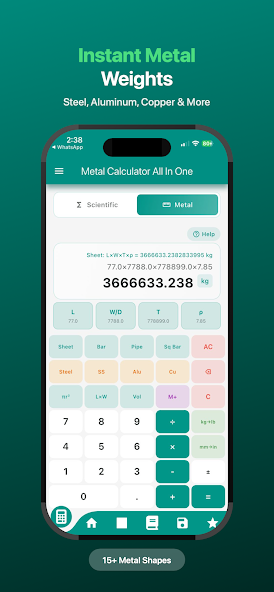
Weight, with the formula shown 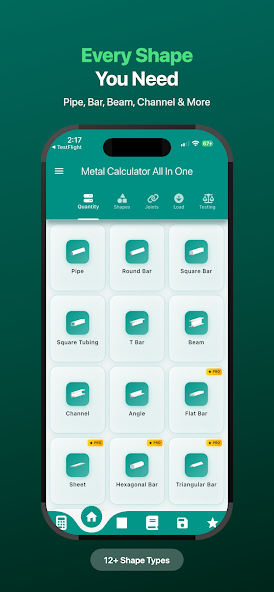
12+ section shapes 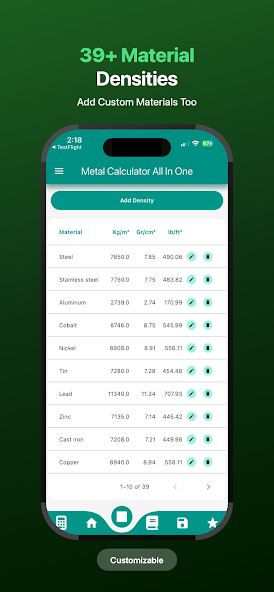
39 densities, plus your own 
Weld, bolt and rivet joints
What it does
- Weight and quantity for pipe, round bar, square bar and square tubing, T bar, beam, channel, angle, flat bar, sheet, hexagonal pipe and triangular bar
- 39 built-in material densities — steel, aluminium, copper, cast iron, zinc, lead, tin, nickel, cobalt, magnesium, tantalum, glass and coal among them — plus custom densities you add yourself
- Frame and grill designer for square and round bar, so you can price a fabricated design rather than a raw section
- Joint calculations across welded (corner, lap, tee, edge), bolted (blind bolt, clevis, pin bolt, lap bolt) and riveted (lap, butt, flush, pan, snap) types
- Material testing calculators — fatigue, bend, Brinell hardness, impact and tensile
- Structural load analysis for dead, live, wind, earthquake and snow loads
- Unit converters for length, volume and density
- PDF reports you can send to a client or keep against the estimate
- Fully offline, with imperial and metric throughout
The app is free to download, and the everyday weight and quantity work is free to use. The advanced sections, joint types, load cases and the frame and grill designer unlock through an in-app purchase — those items are badged inside the app, so you can see what sits where before paying for anything.
Metal Calculator A1 PRO — free to install on Android and iOS
Built for fabricators, contractors, mechanical engineers and anyone who has to price steel before the day ends.
Frequently asked questions
What is the formula for metal weight?
Weight = Volume × Density. For any constant section, volume is the cross-section area multiplied by the length, so weight in kilograms equals area in square millimetres × 0.000001 × length in metres × density in kg/m³. Every shape-specific formula on this page is that one equation with a different area term substituted in.
How do you calculate the weight of a steel round bar?
Square the diameter in millimetres, multiply by π ÷ 4 to get the area in mm², multiply by 0.000001 and by 7850 kg/m³. A 16 mm mild steel round bar works out at 1.578 kg per metre, so a 12 m bar weighs 18.94 kg.
Why is steel bar weight calculated as d² ÷ 162?
It is the full formula with the constants collapsed. (π ÷ 4) × 0.000001 × 7850 = 0.0061654, and 1 ÷ 0.0061654 = 162.196. So d² ÷ 162.196 gives kilograms per metre exactly, and the trade rounds it to 162. The shortcut only holds for steel at 7850 kg/m³ — it is wrong for aluminium, copper or brass.
What is the density of mild steel?
7850 kg/m³, which is 7.85 g/cm³ or 490.06 lb/ft³. Stainless steel is heavier at 7750 to 8000 kg/m³ depending on grade, and aluminium is roughly a third of steel at 2739 kg/m³.
How do you calculate pipe weight?
Use A = π × t × (OD − t), where OD is the outside diameter and t the wall thickness, both in millimetres. A 114.3 mm OD pipe with a 6 mm wall has an area of 2041.41 mm², which at 7850 kg/m³ gives 16.03 kg per metre. The trade shortcut (OD − t) × t × 0.02466 returns the same number for steel.
Does the calculated weight match what the supplier delivers?
Rarely to the last kilogram. Theoretical weight assumes nominal dimensions and a sharp-cornered section. Rolling tolerance, root radii on angles and channels, mill scale and coatings all move the weighbridge figure, usually within 2 to 5 percent. Use theoretical weight to check an invoice, not to replace it.
Is Metal Calculator A1 PRO free?
It is free to download on Android and iOS, and the everyday weight and quantity calculations are free to use. Some advanced sections, joint types, load cases and the frame and grill designer unlock through an in-app purchase. The locked items are badged inside the app, so you can see what sits where before paying for anything.
Does Metal Calculator A1 PRO work offline?
Yes. Every calculation runs on the device, which is the point on a site or in a fabrication shop with no signal. An internet connection is only needed for updates.
Can it handle imperial units?
Yes. The app supports both imperial and metric measurement systems, and includes length, volume and density unit converters.
Which metals does the app support?
Steel, aluminium, copper, cast iron, zinc, lead, tin, nickel, cobalt, magnesium, tantalum, glass and coal are among 39 built-in densities, and you can add your own material density for any alloy that is not listed.
Built by Binary and Bricks — a team of engineers making software for the people who actually build things.